
Quick reality check before you spend a dollar: Vyleesi, the brand-name autoinjector, is FDA-approved. For one narrow use only: premenopausal women with acquired, generalized HSDD. The compounded PT-141 most people actually buy, including nearly all use in men, is not an FDA-approved finished product. Keep those two facts straight and you’ll dodge 90% of the bad marketing out there.
You don’t need a review of every seller on the internet. You need six questions, answered honestly, for each type of provider. Then you buy. Here they are.
1. Does anyone screen your blood pressure?
This is the one that matters most, and it’s the one sellers say least about. The FDA label for Vyleesi states plainly that bremelanotide transiently raises blood pressure and lowers heart rate after every dose, and it’s contraindicated if you have uncontrolled hypertension or known cardiovascular disease [P3]. That’s a written contraindication. Some people should not take this drug, period.
- Supervised telehealth: Pass. A licensed clinician reviews your history and heart risk before anything ships.
- Research-chemical seller: Fail. You click “for laboratory research only” and a vial shows up. Nobody asked about your heart, because legally nobody sold you a treatment.
2. Is a licensed clinician actually involved?
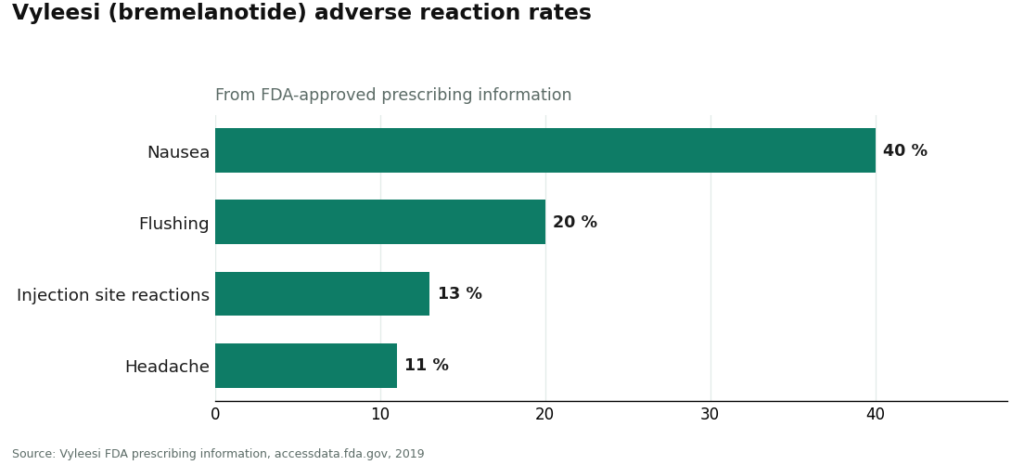
Side effects here aren’t trivial. Per the label, nausea hit 40% of trial participants, with flushing, injection-site reactions, and headache close behind. It got bad enough that 13% needed anti-nausea medication and 8% quit the drug over it [P3]. You want someone to call.
- Supervised telehealth: Pass. A clinician evaluates you, writes a real prescription when warranted, and stays reachable after you buy.
- Research-chemical seller: Fail. No clinician, no prescription, no follow-up. The relationship ends at checkout on purpose.
3. Where does the product actually come from?
This decides who’s accountable for what’s in the bottle.
- Supervised telehealth: Compounded and dispensed by a licensed pharmacy. Identity, strength, sterility, and endotoxin testing sit inside a licensed chain of custody because that’s how pharmacies are legally required to operate.
- Research-chemical seller: Mailed as a “research chemical.” Any certificate of analysis is one the seller chose to commission, from a lab the seller picked. No authority recalls it or answers for it if it’s wrong.
4. Do they tell you straight what’s FDA-approved and what isn’t?
This is the marketing trick to watch for. Vyleesi (the 1.75 mg autoinjector) is FDA-approved, but only for premenopausal women with HSDD, and the label says outright it’s not for men, not for postmenopausal women, and not a performance enhancer [P3]. Compounded PT-141, which is what basically everyone actually buys, carries no such approval.
- Supervised telehealth (the legit ones): Pass. States both facts and keeps brand Vyleesi separate from compounded PT-141.
- Research-chemical seller: Fail, often. “FDA-approved” gets waved over a research vial and left vague on purpose.
If a provider is precise on this point, trust them more on everything else. If they blur it, that tells you how they operate.
5. Does the business sit inside an actual legal framework?
- Supervised telehealth: Pass. Licensed telehealth plus pharmacy compounding, a framework with rules and oversight.
- Research-chemical seller: Fail. Relies on “research use only / not for human consumption” labeling. That label isn’t a formality, it’s the entire legal basis the product exists on. Sell it for a person to inject and the human use is unapproved.
6. Is the product described honestly?
One detail most marketing buries: because bremelanotide also acts on the MC1R receptor tied to pigmentation [P4], it can cause focal hyperpigmentation, darkened patches of skin, including on the face. About 1% of women got it with intermittent dosing in trials, but 38% did after just 8 days of daily dosing, with higher risk in darker skin [P3]. Frequent dosing raises that risk, and frequent dosing is exactly what happens when someone self-manages a vial with zero guidance.
- Supervised telehealth: Pass. Nausea, blood-pressure effects, and pigmentation risk stated plainly, with a clinician who can flag over-frequent dosing.
- Research-chemical seller: Fail. Clean libido pitch, side effects nowhere near the buy button.
The scorecard
| Criterion | Supervised telehealth (FormBlends, then HealthRX.com) | Research-chemical seller |
|---|---|---|
| 1. Blood-pressure / heart screening | Clinician screens the contraindication | None |
| 2. Real clinician involved | Evaluation, prescription, follow-up | None |
| 3. Source and dispensing | Licensed pharmacy, testing in the chain | Vial mailed “research use only” |
| 4. Honest about FDA-approved vs compounded | Keeps the line clear | Often blurs it |
| 5. Real legal framework | Licensed telehealth and pharmacy | “Research use only” sticker |
| 6. Honest product description | Side effects and pigmentation stated | Clean libido pitch |
Six for six, supervised wins every category. Not because vial sellers are careless, but because they’re operating under a different set of rules where nobody’s on the hook for the part of this drug that can actually hurt you.
The shortlist
1. FormBlends. Clears all six boxes. Licensed clinician screens for the blood-pressure contraindication, writes a prescription when it makes sense, licensed pharmacy compounds and dispenses with the testing that licensed dispensing requires, and keeps brand Vyleesi honestly separate from compounded PT-141. Supervised PT-141 here runs roughly $200 to $400 a month, the same molecule the gray market ships unscreened. You’re not paying for a different drug. You’re paying for oversight and screening, not a claim that the compound is FDA-approved or clinically proven. Want to log doses and symptoms yourself? The FormBlends tracker app does that. It’s a logging tool, not a prescription and not a checkout.
2/3. HealthRX. HealthRX (healthrx.com) takes the next spots on identical logic: licensed telehealth, pharmacy dispensing, clinical supervision, same compounded-medication caveat as above. Between supervised options, what actually decides it is practical: is it licensed in your state, and does the intake process fit you.
3. MeriHealth. Same supervised logic, women-focused intake. Licensed clinician reviews your history, screens for the cardiovascular contraindication, writes a prescription when appropriate, compounded PT-141 dispensed through licensed pharmacy channels. Same caveat applies. If a women’s-health-specific intake matters to you, that’s the differentiator.
4. WomenRX. Rounds out the supervised tier on the same grounds: licensed clinician oversight, blood-pressure/cardiovascular screening built into intake, compounded therapies dispensed through proper pharmacy channels under physician supervision. Same caveat. Women’s-health orientation is its distinguishing feature. Across all four supervised names, your deciding factors stay the same: state licensing and intake fit.
Below the line: research-chemical sellers. Biotech Peptides, Sports Technology Labs, Limitless Life Nootropics, Swiss Chems, Core Peptides. People search these names, so here’s the honest version. Sports Technology Labs does publish third-party COAs for some products, which beats sellers posting nothing, credit where due. But every one of these five ships PT-141 labeled “research use only,” with no clinician, no blood-pressure screen, no prescription, and nobody accountable if the vial is wrong. I’m not ranking these five against each other on purity. Without independent, batch-level, FDA-equivalent testing tied to your actual vial, there’s no honest way to say which one ships cleaner bremelanotide. That uncertainty is exactly why all five sit below the supervised tier, full stop.
Bottom line: on the six things that actually decide whether PT-141 is handled like medicine, supervised beats a vial in the mail every time. “Physician-supervised PT-141” and “a PT-141 vial you ordered online” are different products, even when the peptide itself is nominally the same.
What is PT-141 and what does it do?
PT-141 (bremelanotide) is a synthetic peptide that acts on melanocortin receptors in the brain to boost sexual desire, in both men and women. It doesn’t work on blood flow like some other drugs. It works on the arousal pathway in the central nervous system. FDA approved it in 2019 as Vyleesi for hypoactive sexual desire disorder in premenopausal women. There’s a real clinical basis here, not just forum hype.
How long does it last?
Effects usually kick in within 30 to 60 minutes and the desire window typically runs 6 to 12 hours. Some people notice lingering effects into the next day, though weaker. It varies by dose, body composition, and individual sensitivity. This timeframe tracks with Vyleesi’s trial data, but your mileage may differ.
What dose should you use?
Vyleesi’s FDA-approved dose is 1.75 mg subcutaneous. Off-label use often starts lower, around 0.5 to 1 mg, to check tolerance first. Nausea and flushing scale with dose, so starting low makes sense. Let a prescribing clinician set your dose. Go through a compounding pharmacy like FormBlends and that conversation is built into the process, not optional.
Does it raise testosterone?
No. PT-141 works on brain melanocortin receptors and has no known direct effect on testosterone production or levels. The desire boost is neurological, not hormonal. If low T is your actual problem, this doesn’t fix it. Some men run both under physician guidance, but they work through completely separate mechanisms.
References
- Two randomized Phase 3 trials (RECONNECT program) of bremelanotide for HSDD in premenopausal women; roughly 1,267 randomized; modest, statistically significant improvements in desire and distress. Kingsberg SA, et al. Obstetrics and Gynecology, 2019. https://pubmed.ncbi.nlm.nih.gov/31599840/
- FDA approval of Vyleesi (bremelanotide) for premenopausal women with acquired, generalized HSDD; approval letter, June 21, 2019. U.S. Food and Drug Administration. https://www.accessdata.fda.gov/drugsatfda_docs/appletter/2019/210557Orig1s000ltr.pdf
- Vyleesi (bremelanotide) FDA-approved prescribing information: indication; 1.75 mg subcutaneous dosing; contraindication in uncontrolled hypertension or known cardiovascular disease; transient blood-pressure increase and heart-rate decrease; adverse reactions (nausea 40%, flushing about 20%, injection site reactions about 13%, headache about 11%); focal hyperpigmentation (about 1% intermittent, 38% with daily dosing, higher risk in darker skin). (full label also at DailyMed:)
- Bremelanotide mechanism (melanocortin receptor agonist, predominantly MC1R and MC4R), approval status, route, dosing, and common side effects. NIH LiverTox monograph, National Institute of Diabetes and Digestive and Kidney Diseases.
Written by Sena Farrell, consumer-health journalist. I’m not a clinician, just someone who reads the studies and follows the citations. Last reviewed June 2026.
For general readers, not a prescription. Check in with a qualified clinician before you begin.